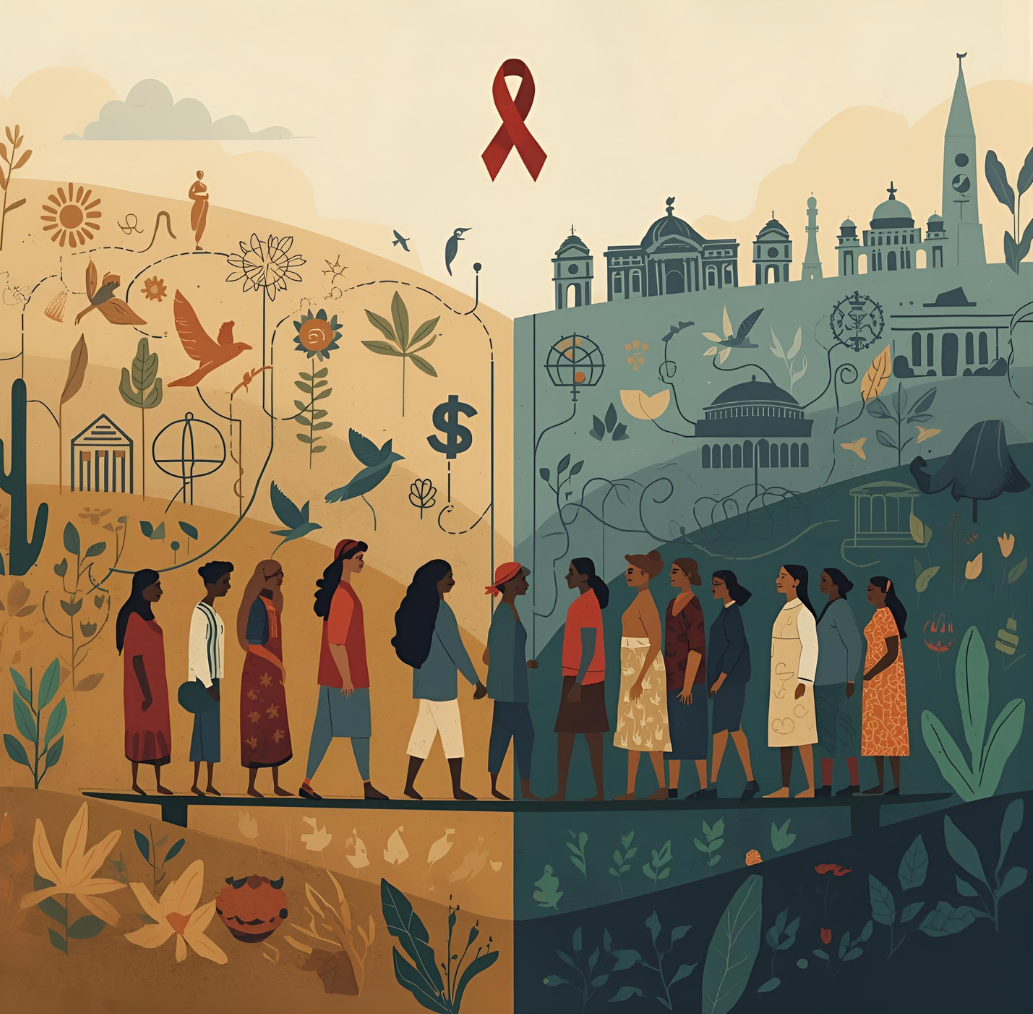
The Global Fund transition is most often approached as a financial exercise. It is thought of in terms of gradual cost recovery, domestic co-financing, and integration of services into national systems. This interpretation is necessary, but it remains insufficient. Beyond budget lines, the transition reveals how HIV response systems have been constructed, and more specifically, the actual place given to community actors in these systems.
For sub-recipients involved in the HIV response, the transition raises more than just the question of continuity of activities. It also raises questions about their institutional status, their capacity to endure, and their political recognition beyond international funding cycles. Can they evolve from a role as technical operators to that of actors fully integrated into the governance of public health policies, or will they remain structurally dependent on externally defined frameworks and resources?
Essential actors, but structurally dependent
In many contexts, community sub-recipients play a central role in the response to HIV. They ensure access to services for key populations, maintain links with people who are often distant from the health system, and implement interventions that require social proximity and a relationship of trust that institutional structures sometimes struggle to establish.
However, this operational centrality contrasts with their institutional position. The recognition they receive remains largely functional. It is expressed through delivery mechanisms, performance indicators, and reporting obligations, but much less through effective participation in strategic decision-making spaces. This dissociation between operational responsibility and decision-making power creates a structural vulnerability that is particularly visible at times of transition.
Critical literature on development aid sheds light on this dynamic. Aid dependency is not limited to a financial constraint; it refers to a political configuration in which local actors operate within frameworks largely defined by external priorities, limiting their strategic autonomy and capacity for influence. In the response to HIV, this dependence translates into the political invisibility of community actors, who are recognized for what they do, but rarely for what they know and what they could contribute to decision-making.
Transition as a revelation of a blind spot: the absence of consolidation trajectories
The Global Fund's transition also highlights a structural blind spot: the absence of explicit consolidation or “graduation” pathways for sub-recipients. In other areas of development, particularly social protection, graduation refers to progressive and planned pathways aimed at strengthening the institutional and financial capacities of actors until they achieve a level of relative autonomy compatible with national ownership.
In the response to HIV, this logic is largely absent. Transition frameworks focus primarily on service continuity and budgetary takeover by the state, without defining thresholds of organizational maturity or intermediate strengthening objectives for community-based organizations. Sub-recipients are thus expected to be sustainable without systematic investments being made in their internal governance, strategic planning, stabilization of human resources, or capacity to mobilize domestic funding.
This lack of planned trajectories weakens the transition. It transforms a process that is supposed to be gradual and anticipated into a moment of increased vulnerability for actors who are nevertheless indispensable to the response.
International frameworks: clear principles, limited prescriptions
The Global Fund's policies on sustainability, transition, and co-financing explicitly recognize that community-based services, particularly those targeting key populations, are at significant risk when domestic financing mechanisms are not in place. Similarly, the UNAIDS Global Strategy emphasizes the central role of civil society and the need to preserve a functional space for community-based organizations.
However, these frameworks remain vague on the concrete modalities for institutional strengthening of sub-recipients. They set out principles but leave considerable room for interpretation in national contexts. In the absence of clear operational frameworks, transition preparations tend to focus on macro-financial aspects at the expense of organizational consolidation of community actors.
The transition in Tunisia: anticipating the post-Global Fund era without weakening the community response
In Tunisia, the post-Global Fund transition is explicitly anticipated and discussed. But, as in many contexts, the challenge is not simply to “replace” one source of funding with another. It is to protect, over the long term, the functions most exposed to a gradual withdrawal of aid: community access to services, continuity of support, maintaining links with key populations, and more broadly, the system's capacity to reduce disruptions in care pathways.
The available national analyses converge on one key point: the structural dependence of community-based organizations on external funding remains high, not only for activities but also for institutional functioning (human resources, management systems, monitoring mechanisms, logistics). This dependence, when not offset by internal consolidation and planned domestic relays, creates a specific vulnerability. It exposes organizations to a rapid contraction of their capacities at a time when the response requires stability, proximity, and trust.
In this context, the Tunisian issue directly refers to the blind spot highlighted in the rest of the article: the absence of a clear framework for progress toward sustainability. In other words, the transition cannot be based on an implicit injunction to community actors to “hold on” or “become autonomous” without a structured trajectory. What Tunisia needs is an explicit consolidation path, with stages, objectives, and indicators of organizational maturity. A “smooth” transition involves, in particular, clarifying what it means, in operational terms, for a sub-recipient to be “ready”: internal governance, financial compliance, strategic planning, human resource management capacity, risk management, and the ability to diversify resources. Without these benchmarks, there is a risk of confusing short-term implementation performance with long-term institutional strength.
A credible transition in Tunisia must be conceived as a set of complementary strategies, articulated over time. Among the options generally discussed at the national level, several appear particularly consistent with the structural challenges identified. First, explicit budgeting for critical HIV priorities and planning for resource mobilization, to avoid the transition resulting in a succession of ad hoc micro-solutions. Second, the identification of domestic financing mechanisms adapted to community interventions (whether grants, service purchases, or mixed financing), with explicit attention to multi-year funding and coverage of structural costs. In this context, mechanisms such as “social contracts” can be considered as one tool among others, provided that they are part of an overall transition strategy, that they do not replace broader institutional strengthening, and that they preserve the autonomy, advocacy capacity, and critical role of community organizations.
At the same time, the transition must include a systematic strengthening of community monitoring and accountability as tools for quality and equity, rather than treating them as optional “activities.” Finally, anticipation must focus on the continuity of the screening-care-retention continuum, as the transition quickly becomes a performance crisis if disruptions in the pathway increase.
Conclusion
The Global Fund transition cannot be reduced to a financial exercise. It is a moment of truth about how national responses have integrated or marginalized community actors. In Tunisia, as in other contexts, the challenge is to build a gradual and protective transition that can preserve the continuity of community services and consolidate the HIV response without weakening the organizations that are its operational pillars.
Sustainability does not rely on a single lever but on a thoughtful combination of institutional, financial, and governance strategies. Only then can the transition become a process of consolidation rather than an additional factor of vulnerability.
Références
- Mosse, D. (2005). Cultivating Development: An Ethnography of Aid Policy and Practice. Pluto Press.
(Mobilisé pour le cadre conceptuel de la dépendance à l’aide et l’invisibilisation politique des acteurs locaux.) - Sabates-Wheeler, R., & Devereux, S. (2013). Sustainable graduation from social protection programmes.
Development and Change, 44(4), 911–938.
https://onlinelibrary.wiley.com/doi/10.1111/dech.12029
(Mobilisé pour la notion de trajectoires de consolidation / graduation.) - The Global Fund. (2024). Sustainability, Transition and Co-Financing Policy (Board-approved).
https://www.theglobalfund.org/media/14383/core_sustainability-transition-cofinancing_policy_en.pdf
(Mobilisé pour les principes de transition, durabilité et risques pour les services communautaires.) - UNAIDS. (2021). Global AIDS Strategy 2021–2026: End Inequalities. End AIDS.
https://www.unaids.org/sites/default/files/media_asset/global-AIDS-strategy-2021-2026_en.pdf
(Mobilisé pour le rôle central de la société civile et l’équité dans la riposte VIH.) - UNAIDS. (2023). UNAIDS Data 2023. https://www.unaids.org/en/resources/documents/2023/2023_unaids_data
- Cornwall, A. (2008). Unpacking “Participation”: Models, meanings and practices.
Community Development Journal, 43(3), 269–283.
https://www.researchgate.net/publication/31091334_Unpacking_'Participation'_Models_meanings_and_practices - Rifkin, S. B. (2009). Lessons from community participation in health programmes.
Health Policy and Planning, 24(3), 193–201.
https://www.researchgate.net/publication/260336920_Lessons_from_community_participation_in_health_programs - UNAIDS. (2021). Establishing community-led monitoring of HIV services.
https://www.unaids.org/sites/default/files/media_asset/establishing-community-led-monitoring-hiv-services_en.pdf
(Mobilisé pour le suivi communautaire comme levier de qualité, d’équité et de redevabilité.) - World Health Organization (WHO). (2024). Sustaining HIV, viral hepatitis and STI priority services in a changing funding landscape.
https://cdn.who.int/media/docs/default-source/hq-hiv-hepatitis-and-stis-library/sustaining-hiv--viral-hepatitis-and-sti-priority-services-in-a-changing-funding-landscape_pre-launch.pdf?sfvrsn=a7d3ea3f_6 - UNDP. (2022). Social contracting for effective service delivery under domestically funded HIV programmes.
https://undp-capacitydevelopmentforhealth.org/social-contracting-for-effective-service-delivery-under-domestically-funded-hiv-programmes/
(Mobilisé pour positionner les contrats sociaux comme option parmi d’autres, sous conditions.) - République tunisienne. (2013). Décret n°2013-5183 fixant les critères, procédures et conditions d’octroi du financement public aux associations.
Journal Officiel de la République Tunisienne. - Amira Médimagh, PNLS, The global fund (2023). Note analytique – Financement public des associations et contrats sociaux.
Member discussion: